
In Conversation With Michiel Simons
Photography by J. van de Gruiter
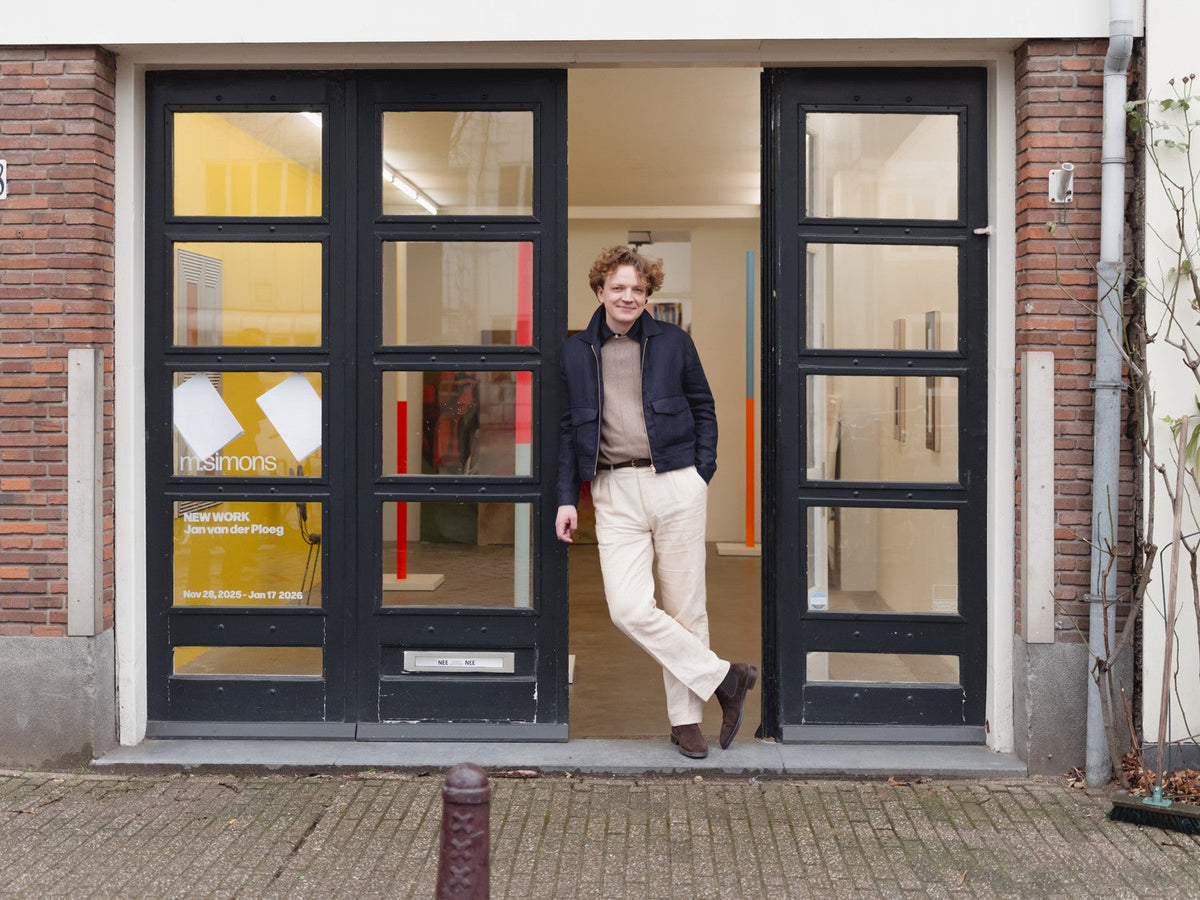
Walking along the Lijnbaansgracht, it would have been hard to miss the bright yellow wall inside M. Simons. It immediately draws attention and invites you in. It was not a new look for the gallery, but part of an exhibition. When we visited, the gallery was showing work by Jan van der Ploeg. The wall had been painted by Van der Ploeg himself for the exhibition, consistent with his history of wall paintings.

The atmosphere is quiet and deliberate. Works are given space, and the setting does not try to compete with them. You are expected to look closely.
Michiel Simons did not study art history. He studied business, and entered the art world by working his way in from the ground up. Early on, he chose internships and junior positions as a way to learn from proximity. He sought out mentors, asked for reading lists, and spent years working alongside dealers and historians. Knowledge, for him, is built over time, through repetition and exposure.
 |
 |
A formative period was his time at Willem Baars Projects in Amsterdam. There, the focus was on mid-career artists and on thinking in terms of an oeuvre rather than individual works.
"The question was not whether something was new, but whether it would hold up. How does a practice develop over time? What remains consistent?"
That way of thinking still shapes M. Simons today. The gallery represents a small group of artists at different stages of their careers, while Simons also operates on the secondary market. Representation requires long-term commitment. When considering new work, he looks for practices that can develop further. Can the artist push their ideas? Are the questions in the work still open?

What connects the gallery is not a single style, but an interest in process and construction. During our visit, works by Hans Hoekstra and Kristoffer Zeiner were on view alongside Van der Ploeg. Together, they reinforced the gallery’s focus on material and structure.
In the centre of the space stood a chair by Hadrien Gérenton. It could be used, but it was not presented as conventional furniture. Its translucent surfaces and slender construction drew attention to material behaviour. In this context, the chair functioned much like the works on the wall: as an object to be considered for how it was made.
 |
 |
Simons also deals on the secondary market. At PAN Amsterdam, works by Picasso were shown at his stand. When asked how such a well-known artist fits within the gallery’s vision, Simons points not to prestige but to process.
"Picasso’s work in lithography, particularly through his collaboration with Atelier Mourlot, pushed the technical possibilities of printmaking."
For Simons, that spirit of experimentation connects directly to the concerns he values today.
This emphasis on process shapes how he speaks about collecting. Taste, he believes, is something that develops gradually. It requires reading, looking, and spending time with work beyond the first impression. The shift happens when you move beyond the initial reaction and allow something to sit.

Over time, collectors sometimes look back at their first purchases and see them differently. For Simons, that is not a failure but part of growth. Early choices reflect who you were at the time. Without them, you would not have developed further. He draws a parallel with clothing.
"What once felt convincing may later feel excessive or obvious. That does not invalidate the earlier decision. It simply reflects a change in perspective. Over time, those preferences begin to align across disciplines. An interest in material or construction in art may echo in architecture, design, or film."
He prefers to grow the gallery carefully. International fairs, talks, and group exhibitions are part of that plan, but not as expansion for its own sake. The aim is to deepen what is already there rather than dilute it.
M. Simons is built on attention to material, to the maker, and to knowledge developed through looking. The gallery does not attempt to explain the work for you. It provides the space and expects engagement.