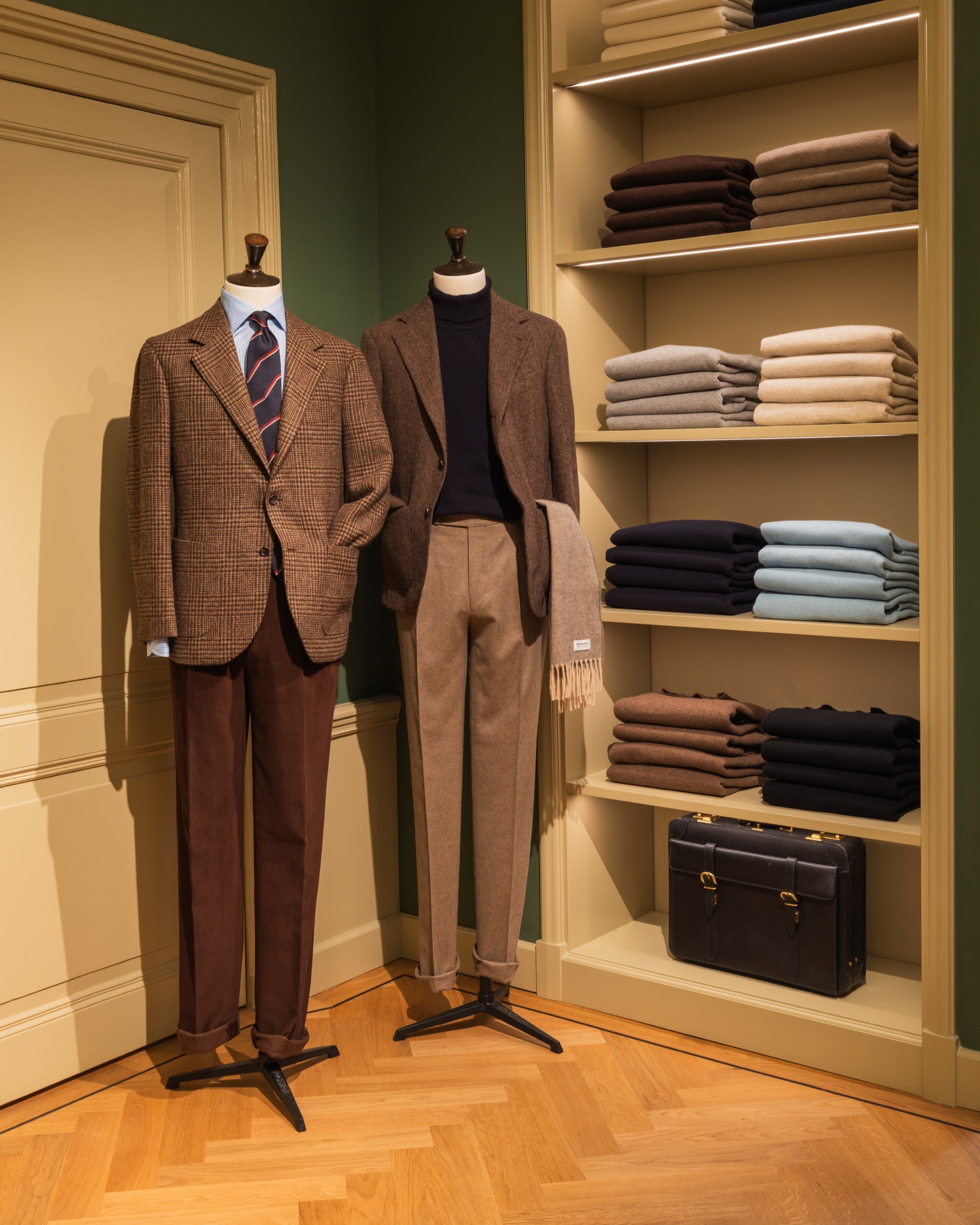

A Guide to Autumn and Winter Trousers
The temperatures may be lower and the days shorter, but the autumn and winter seasons make up for it by giving men the chance to wear heavier fabrics with far more texture than their spring/summer equivalents. It’s a rule that applies not only to jackets (tweed springs to mind), but to trousers as well.
From corduroy to cavalry twill, moleskin to flannel, there’s no shortage of worthy fabrics to consider for winter trousers. And while the character of the cloth will play a role in how formal or casual the trouser is perceived, a more subtle consideration is the trade-off between texture and shape retention. Woollen-spun cloths such as flannel and tweed have depth, warmth and a soft surface, but they hold a crease less. Worsted cloths such as cavalry twill, gabardine and high-twist wool hold the line far better but provide less surface interest.
Ultimately, the “correct” choice of fabric (if such a thing exists) will be determined by the wearer’s own needs and preferences. With that in mind, let’s take a tour of our perennial autumn favourites.
Flannel
Flannel could be considered the vanilla ice cream of autumn/winter fabrics. It’s universally known, always available and instantly familiar.
"If someone is building an autumn and winter wardrobe, mid-grey flannel is the first pair of trousers I would suggest,” says Victor Besnard. “It works with a navy or brown sport coat, a green tweed, and with almost anything else you put above it. The fibres are dyed before spinning, in slightly different shades, which gives flannel its mottled surface, so the grey has depth up close and still reads as a quiet, plain colour from across the room."


Flannel does come in different flavours: woollen-spun and worsted. A woollen flannel is milled from shorter fibres and then teased out until its weave disappears, giving it a slightly fuzzy, brushed appearance and a spongy hand-feel. It’s a delightful texture and what one likely thinks of when flannel comes to mind, but it will also bag out slightly and hold its crease for a shorter period of time. In contrast, a worsted flannel is more tightly woven from longer fibres, giving it a crisper appearance and the ability to better hold its shape.
Flannel varies in weight, from around 10oz on the lighter side to 18oz or more at its heaviest (the weightiest often come from English mills). The heavier a flannel is the better it will drape and retain its crease, though some will find heavyweight flannel to be impractical in environments with excessive indoor heating.
And then there’s the question of colour. Where flannel is concerned, you might say that there are many shades of grey.

"The next question is usually which grey comes second,” Victor says. “Charcoal is almost as versatile as mid-grey, just as good with navy, brown or dark green, only more sober. Light grey is brighter and less discreet. In the end it comes down to the wearer: some wear light grey with more conviction, others are more at ease in the darker shade."
And while the grey flannel trouser is rightly considered an icon, other colours are not verboten. In particular, a fawn or mid-brown flannel trouser has much the same versatility as a grey pair while being a bit more interesting and original.
While supremely versatile, a flannel trouser’s best friend is tweed. This is because the two fabrics share a similar texture, just in different scales. Texture-with-texture is the winter principle.
Cavalry Twill
Cavalry twill is a worsted wool fabric with a steep, double twill weave that provides plenty of natural stretch while resisting wrinkles. These properties made the hard-wearing cloth popular among equestrians and will still be appreciated among modern commuters today.
"Cavalry twill is a worsted with a steep double twill, and it is a firm cloth, so the trousers keep their shape through the day,” Victor says. “Where flannel has that soft, mottled surface, cavalry twill is smooth, but the steep double twill gives it a visible rib, which makes it more interesting than a gabardine.”

Tan, fawn and olive are the classic colours for cavalry twill trousers, though not the only options. “It is at its best yarn-dyed,” Victor continues. “The yarns vary slightly in colour, and in the greys and browns especially that gives the cloth real depth. Cavalry twill sits under almost anything, from tweed to a navy blazer, which is why it is one of the most useful non-grey trousers.”

Corduroy
Corduroy is among the most characterful of all cold-weather fabrics and instantly recognisable by its raised ridges, called “wales.” Its appearance will vary based on the “wale count,” which is calculated by the number of wales per inch. A wide-wale corduroy will have between six and 10 wales per inch, while a mid-wale is one that has between 11 and 14; anything higher may be considered a “pinwale” or “needlecord.”
There is an old story that its name comes from the French corde du roi, meaning “cloth of the king.” This is apocryphal, unfortunately, as its historic origins are anything but regal. Instead it was a working man’s fabric, woven inexpensively from cotton and prized for its robust character.


"Corduroy comes from workwear, so even as a proper tailored trouser it keeps a certain nonchalance,” Victor says. “It is informal without being casual, and that is exactly why I like it. The ridges are a cut pile that traps air, so it is also one of the warmest trouser cloths we carry."
It is a sturdy cloth, but due to its raised pile will show visible signs of wear. This happens most frequently at the knee and seat where the wales will flatten over time from friction. Rather than being viewed as a drawback, many consider this part of its charm. It is as a result a more casual fabric choice and pairs particularly well with knitwear and “country” cloths like tweed rather than smarter business wear.
Moleskin
While less ubiquitous than corduroy, moleskin is another cold-weather cotton fabric that deserves more attention. It is a dense, heavy weave with a sueded hand—hence, “mole skin”—that softens considerably with wear. It’s also among the most casual of autumn/winter fabrics, and pairs well with brushed Shetland sweaters, shawl collar cardigans and tweed. While not a part of Besnard’s ready-to-wear range, moleskin trousers can be ordered made-to-measure.
Cotton
Cotton is considered a year-round cloth. But in a heavier weight, 14oz or above, cotton makes for an excellent tailored trouser or casual chino for the autumn/winter months. It does not retain its colour as strongly as wool, particularly when dyed in darker shades. Instead, the cotton gradually fades with washing, which many find to be a factor in its favour. It will also not hold a crease as sharply as a wool trouser, but that is also considered a part of its charm.

“For cotton trousers, I usually suggest Brisbane Moss or Holland & Sherry,” Victor says. “Holland & Sherry offers a beautiful quality at 460 grams, with a visible twill and a slight brushing that gives it an almost suede-like look. The colour range is very good as well.”
Tweed
There is not a hard-and-fast definition for tweed, but it’s genuinely considered to be a heavier weight, 100% woollen fabric, historically milled in the UK in country colours (Harris Tweed, meanwhile, is defined by an Act of Parliament and must be woven in the homes of workers on Scotland’s Outer Hebrides islands using manually powered looms).
Tweed is primarily a jacketing cloth but can be useful in making trousers. Donegal tweed, traditionally woven in Ireland and marked by its colourful flecks, makes for a versatile yet interesting trouser in neutral hues like grey.
A heavyweight tweed will hold a crease better and prove more resistant to abrasions but may also feel less comfortable thanks to its hairy, scratchy texture. The solution to this problem is to line the trouser to the knee in a smooth, slippery fabric like viscose or cupro.
Year-Round Fabrics
This article’s focus so far has been on fabrics suitable for autumn/winter weather, which misses a frequent problem of modern life: the weather doesn’t always act according to season. In the case of unseasonably warm or humid weather, consider a proper year-round fabric like high-twist wool or gabardine. Both breathe more easily than their autumn/winter equivalents but remain versatile enough to be worn under knitwear and tweeds.

Final Thoughts
If you take away anything from this article, it should be that the autumn and winter seasons are spoiled with choice when it comes to trouser fabrics. While what fabrics are best suited to an individual’s wardrobe will vary from person to person, those just building out their closets would be well-served by selecting a flannel or cavalry twill that could be worn under a sport jacket, as well as either a corduroy or moleskin that pairs with casual tweeds and weekend knitwear. Those potential combinations are a perfect place to start—now go make the most of that cool, crisp weather before we’re all sweating once more.